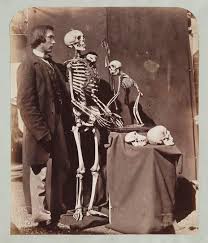
The image I have chosen for this activity is called “Reginald Southey with Skeletons,” taken by Charles Lutwidge Dodgson, a.k.a. Lewis Carroll, in Oxford, England in June of 1857. The picture has Reginald, A medical student at the University of Oxford, posing with a human and a monkey skeleton. This is one of the first photographs ever recorded comparing human anatomy to animal anatomy. In the photo, the skeletons appear to be quite similar in size structure. The monkey skeleton appears to be just a bit smaller than the human skeleton at a glance. This image was protected by copyright laws; however, it has been over 100 years since the date of the work’s creation and the copyright has expired. It now exists in the public domain in the host country of the United Kingdom and other countries and areas where the copyright term is the author’s life plus 100 years or fewer.
This image was created in June of 1857 by Charles Lutwidge Dodgson (Lewis Carroll), who is best known for being the primary author of Alice’s Adventures in Wonderland (1865) and Through the Looking-Glass (1872). The image exists within the public domain since the original copyright expired in 1957.
The readings for this week’s homework were intriguing and informative. I know very little about copyrights and the legal framework surrounding them, so the readings helped highlight key points to understand in regard to accommodating copyright law. In the EFF article about the court decision regarding Google Books, the Judge ruled that Google Books project does not infringe on copyright law. This is a huge win for the public domain and librarians, authors, and readers nation-wide. The Author’s Guild sued Google when they found out they were partnering with libraries across the country to digitize books and give full access to the public for free. The Authors Guild argued that this violated copyright laws and kept authors of source material from making money. The courts disagreed with this argument stating that there is a line between intellectual property and open-source knowledge for the world to enjoy. A similar situation has taken place involving Disney’s copyright over Mickey Mouse. Every several decades copyright law expires and Disney lobbies congress to extend the law. This happened in 1976 and 1998 and will continue unless Disney wants to give up billions in intellectual property.
Copyright allows artists and creators to have a sort of physical ownership over their creation and prevents theft. It is how a lot of these artists make money and support themselves. Without copyright laws, there would be a lot less music, pictures, movies, and anything else involving intellectual property. People are not going to make art without the prospect of making money. Copyright affects learning institutions by limiting their ability to use copyrighted content. A lot of content exists in the public domain, but for the stuff that is not, institutions must obtain permission to use copyrighted content. Historical content, like images, should exist in the public domain for anyone to use. Having decades to centuries old pictures trapped behind copyright is not right, and the freedom of students and people wanting to learn should supersede monetary gain.
The image “Reginald Southey with Skeletons,” taken by Charles Lutwidge Dodgson, a.k.a. Lewis Carroll, in Oxford, England in June of 1857 had a copyright at one point, but now exists within the public domain. Copyright allows creators to own and profit from their content. It does bring up an ethical question of locking important historical content that fosters creativity and learning, behind a paywall. Many think that copyright laws should be changed or amended to allow the public use of these images. Should a picture from 500 years ago have copyright?
“Reginald Southey with Skeletons,” taken by Charles Lutwidge Dodgson
Works Cited
- Doctorow, C. (2018, May 5). We’ll probably never Free Mickey, but that’s beside the point. Electronic Frontier Foundation. https://www.eff.org/deeplinks/2016/01/well-probably-never-free-mickey-thats-beside-point
- McSherry, C. (2013, November 14). Court upholds legality of Google Books: Tremendous Victory For Fair use and the Public Interest. Electronic Frontier Foundation. https://www.eff.org/deeplinks/2013/11/court-upholds-legality-google-books-tremendous-victory-fair-use-and-public
Creative Commons
“Reginald Southey” by Charles Lutwidge Dodgson is in the public domain. Available at Wikimedia Commons.

URL: https://commons.wikimedia.org/wiki/File:Reginald_Southey_by_Charles_Lutwidge_Dodgson.jpg
This work is licensed under CC BY 4.0
