Copyright Conundrum

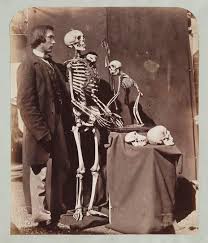
            The image I have chosen for this activity is called “Reginald Southey with Skeletons,” taken by Charles Lutwidge Dodgson, a.k.a. Lewis Carroll, in Oxford, England in June of 1857. The picture has Reginald, A medical student at the University of Oxford, posing with a human and a monkey skeleton. This is one of the first photographs ever recorded comparing human anatomy to animal anatomy. In the photo, the skeletons appear to be quite similar in size structure. The monkey skeleton appears to be just a bit smaller than the human skeleton at a glance. This image was protected by copyright laws; however, it has been over 100 years since the date of the work’s creation and the copyright has expired. It now exists in the public domain in the host country of the United Kingdom and other countries and areas where the copyright term is the author’s life plus 100 years or fewer.

            This image was created in June of 1857 by Charles Lutwidge Dodgson (Lewis Carroll), who is best known for being the primary author of Alice’s Adventures in Wonderland (1865) and Through the Looking-Glass (1872). The image exists within the public domain since the original copyright expired in 1957.

            The readings for this week’s homework were intriguing and informative. I know very little about copyrights and the legal framework surrounding them, so the readings helped highlight key points to understand in regard to accommodating copyright law. In the EFF article about the court decision regarding Google Books, the Judge ruled that Google Books project does not infringe on copyright law. This is a huge win for the public domain and librarians, authors, and readers nation-wide. The Author’s Guild sued Google when they found out they were partnering with libraries across the country to digitize books and give full access to the public for free. The Authors Guild argued that this violated copyright laws and kept authors of source material from making money. The courts disagreed with this argument stating that there is a line between intellectual property and open-source knowledge for the world to enjoy. A similar situation has taken place involving Disney’s copyright over Mickey Mouse. Every several decades copyright law expires and Disney lobbies congress to extend the law. This happened in 1976 and 1998 and will continue unless Disney wants to give up billions in intellectual property.

            Copyright allows artists and creators to have a sort of physical ownership over their creation and prevents theft. It is how a lot of these artists make money and support themselves. Without copyright laws, there would be a lot less music, pictures, movies, and anything else involving intellectual property. People are not going to make art without the prospect of making money. Copyright affects learning institutions by limiting their ability to use copyrighted content. A lot of content exists in the public domain, but for the stuff that is not, institutions must obtain permission to use copyrighted content. Historical content, like images, should exist in the public domain for anyone to use. Having decades to centuries old pictures trapped behind copyright is not right, and the freedom of students and people wanting to learn should supersede monetary gain.

            The image “Reginald Southey with Skeletons,” taken by Charles Lutwidge Dodgson, a.k.a. Lewis Carroll, in Oxford, England in June of 1857 had a copyright at one point, but now exists within the public domain. Copyright allows creators to own and profit from their content. It does bring up an ethical question of locking important historical content that fosters creativity and learning, behind a paywall. Many think that copyright laws should be changed or amended to allow the public use of these images. Should a picture from 500 years ago have copyright?

“Reginald Southey with Skeletons,” taken by Charles Lutwidge Dodgson
Works Cited

  • Doctorow, C. (2018, May 5). We’ll probably never Free Mickey, but that’s beside the point. Electronic Frontier Foundation. https://www.eff.org/deeplinks/2016/01/well-probably-never-free-mickey-thats-beside-point
  • McSherry, C. (2013, November 14). Court upholds legality of Google Books: Tremendous Victory For Fair use and the Public Interest. Electronic Frontier Foundation. https://www.eff.org/deeplinks/2013/11/court-upholds-legality-google-books-tremendous-victory-fair-use-and-public

Creative Commons

“Reginald Southey” by Charles Lutwidge Dodgson is in the public domain. Available at Wikimedia Commons.

URL: https://commons.wikimedia.org/wiki/File:Reginald_Southey_by_Charles_Lutwidge_Dodgson.jpg

This work is licensed under CC BY 4.0

Remixing History: My Green Book Archive

My design and color choices for the illustration of the Green Book show how black travelers had to watch their backs when traveling through the Jim Crow South. The time was very political unstable and lacked social cohesion amongst the general populace. Politically speaking, the country was still dominated by the history of the Civil war. The South voted almost exclusively Democratic for about a century and the North voted heavily Republican. White southerners still reeling from the war of northern aggression wanted nothing to do with the black population, and thought segregation was the best option.

            My user interface immerses the user within the website. It is not overwhelming, but it does highlight the important parts that need to stand out and is overall aesthetically pleasing. I struggled with the customization aspect of the website, and picking out what colors and fonts I was using. I am pretty sure I didn’t do some of the customization aspects of the assignment properly, but I learned a lot in the process. In the future, I would play around with the more advanced settings and customization options. There are a lot of features that can add nice nuance to make the website stand out and look visually pleasing.

            This assignment was a fun activity that allowed me to play around with HTML and CSS and helped me build up some confidence. It made me feel like I was learning something, instead of copying and not retaining any information. I will use the website to not only expand on the current subject matter, but in the future, I will use it for personal hobbies that can use a website. This is also great tool for marketing yourself for a professional career opportunity. For instance, if I was an artist, I could put samples of my work on the website and reference it to interested parties. For me, figuring out how to implement the hover settings for the navigation menu and hyperlinks was the hardest part. I was invariably able to figure it out and add a satisfying setting to user interface. If I was to make any changes in the fture, this is one of the changes that I would mess around with because there are so many different settings and customization options.

Digital History in the News

Do you ever think about what happens to websites or internet services that disappear? Researchers predict that of all the webpages that existed between 2013 and 2023, roughly 25% of them have vanished. The websites that have vanished might not ever be restored, but a non-profit organization called Internet Archive has committed itself to recovering lost data and storing digital data from the world wide web. Internet Archive’s Wayback Machine can recall millions of websites, movies, tv shows, music and songs, etc. Even content that isn’t accessible on the internet today, like the 1977 comedy series Fernwood 2 Night. This organization, comprised mostly of volunteers, is working tirelessly to act as a backdrop for the world’s data storage problem.

            Internet Archive was founded back in 1996 in San Fransico by an internet pioneer named Brewster Kahl. They have challenged themselves with the most ambitious archiving project in history, gathering 866 billion webpages, 44 million books, 10.6 million movies and tv shows, and much more. A few other small volunteer groups are helping them on this ambitious journey to keep the world from digital oblivion, all while storing the data in only a few data centers worldwide.

            Unfortunately, Internet Archive has had legal pushbacks involving copyright infringement and intellectual property. Recently, they were sued by four major book publishers for copyright infringement. They argued that Internet Archives’ practice of scanning physical books and lending out digital copies breaks US copyright law. They lost the case and appeal against the decision. At the present moment, Internet Archive is facing a 400-million-euro lawsuit that jeopardizes the non-profit’s survival.

            Without hard working volunteers to help humanity store its history, it would be lost forever. Thousands of years and billions of pages of information gone by the waste side. This article reflects not only digital storage, but storage as well. Not everything can be stored digitally and not everything can be stored physically. This was a fascinating article because I not only use the Wayback Machine, but I have donated to the Internet Archive personally. Digital history will act as the fundamental backbone for the future of history and academia. Article: https://www.bbc.com/future/article/20240912-the-archivists-battling-to-save-the-internet